Blog
How Fyxer scaled support 17x without lowering the bar

Mads Lunau Liechti
Co-founder


Yannis Karagkiouloglou (Head of Customer Support)
AI support agent name
Parker
Connected tools
Slack, Linear, Notion, GitHub, Cursor, Stripe, HubSpot, DocuSign, PostHog, Growthbook, Churnkey, internal tools
AI engagement rate
88.7%
AI resolution rate
67.3%
AI CSAT score
98%
Summary
Fyxer grew from $1M to $17M ARR in eight months, and Yannis - who had led support teams at Meta, WeTransfer, and Box - had to scale support just as fast. The only realistic way to do that was with AI, but he cares too much about customers to put a generic bot in front of them. Today, Parker, the AI support agent he built on Parahelp, resolves 59.7% of all tickets with a CSAT of 98%, and its insights drive 15% of the product roadmap. This is the story of how Yannis built an AI-native support function where AI doesn't deflect customers - it listens and helps them.
Meet Yannis
Yannis has spent his career leading customer support in tech companies like Meta, WeTransfer, and Box. Today he leads support at Fyxer, an AI executive assistant that grew from $1M to $17M ARR in eight months.
Growing faster than support could
With usage growing seventeen-fold in under a year, the team ran into two problems. They couldn't get to customers' issues fast enough. And the insights buried in those thousands of conversations - what was breaking and what customers wanted - rarely made it to the rest of the company.
Hiring alone could not close the gap. To keep up, the support team would have had to grow at nearly the same pace as the customer base, and every new team member takes months to find, hire, and get up to speed on a product that changes constantly. More people would also not have solved the insights problem, since what customers were saying would just be spread across more team members. The only realistic way to scale support as fast as Fyxer was growing was with AI.
Why Parahelp
Fyxer had an AI support agent before Parker, but it didn’t move the needle.
“Their team didn’t just say ‘here is the tool, implement it’. They understood our main pain points and designed the agent with us, proving it in an A/B test between our prior agent and Parker - within a month, we moved all incoming tickets to it. At the same time, we’re not bottlenecked by the team - we have the Parahelp Internal Agent that continuously helps us with improving the agent, building new knowledge and connections.”
- Yannis
Trust is built by taking action
For Yannis, building trust with customers is very important.
“Being able to personalize everything to the user in the age of AI is what will help build trust. And being able to take action and follow through - that’s what builds trust. As a user, I don’t care who I speak to. Just get it done.”
- Yannis
This is how Yannis approached building Parker, Fyxer's AI support agent. Instead of just answering common questions, Parker needed to be able to take action and follow through in Fyxer's systems, the same way Yannis's own team would.
Customer context doesn't sit in one system - it's spread across the support platform, the CRM, billing, and Fyxer's own backend. An agent that can't see the full customer journey can't match a request to the issue behind it, let alone resolve it.
So far, Yannis has built 28 connections for Parker, enabling it to perform actions in Fyxer's systems such as checking refund eligibility in Stripe, extending trials, sending DPAs via DocuSign, checking HubSpot for an active deal before processing a cancellation, and generating recovery links through Fyxer's own backend - all just by chatting with Parahelp.
“Building Parker on Parahelp has enabled us to not only 10x but 100x the speed at which we build tool connections and unlock extra use cases.”
- Yannis
Resolving their most sensitive request
One of Yannis’ favorite examples is domain migration. When a Fyxer customer changes their email domain, they need to be able to log in with the new one. Because the ticket touches account access, it is one of the most sensitive requests the team handles.
Before enabling Parker to handle those, Yannis was the final approver on every single one to understand the ins and outs of the process.
“Anything you want to automate, you need to do yourself first a few times. You need to understand the edge cases: what could fail, what could go wrong, and what you need to take into account.”
- Yannis
Today, when Parker handles these tickets, it validates the request with the customer, collects evidence to prove the request is legitimate, and sends both to the team in a Slack notification. After a team member approves, Parker generates the sign-in link through Fyxer’s backend and sends it to the customer.
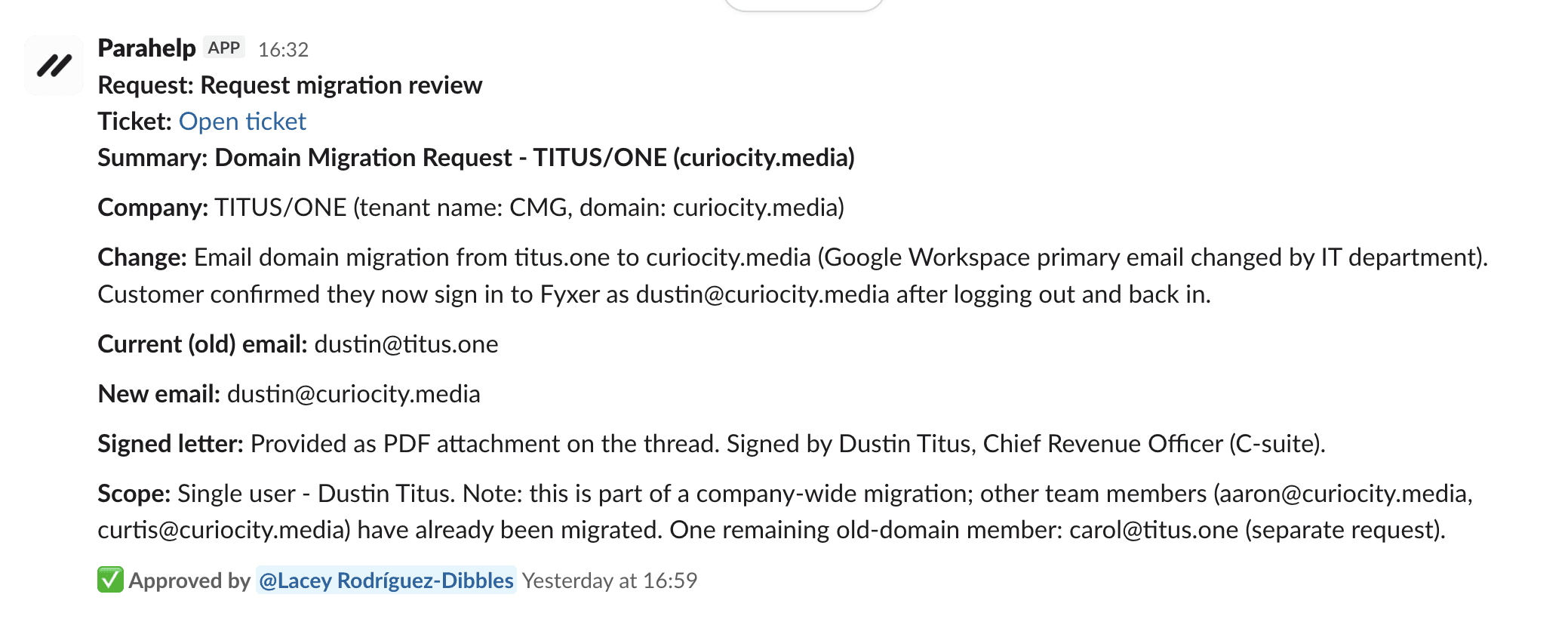
Parker also pays attention to the broader context of the conversation and acts accordingly:
"If it identifies a sales opportunity through that exchange - for example, if they said 'oh, we want to onboard 15 more users' - it will also create a lead in HubSpot and ping the sales team in a specific Slack channel to let them know this has now been created, and the reason why they want this."
- Yannis
Automatically keeping Parker up to date
Fyxer ships product changes constantly, and every change risks making Parker's configurations out of date. To handle this, Yannis set up an automation in Parahelp that keeps Parker up to date automatically.
Every weekday afternoon, it scans Fyxer's product-release channel in Slack and the deployment PRs in GitHub. For each change it finds, it checks PostHog and Growthbook to confirm that the feature is live for all users, not just an experiment or a partial rollout. For everything confirmed, it drafts updates to Parker's configurations and also flags exactly which help center articles are now out of date, routing each to the right person for review.
Here’s an example of an automation output:
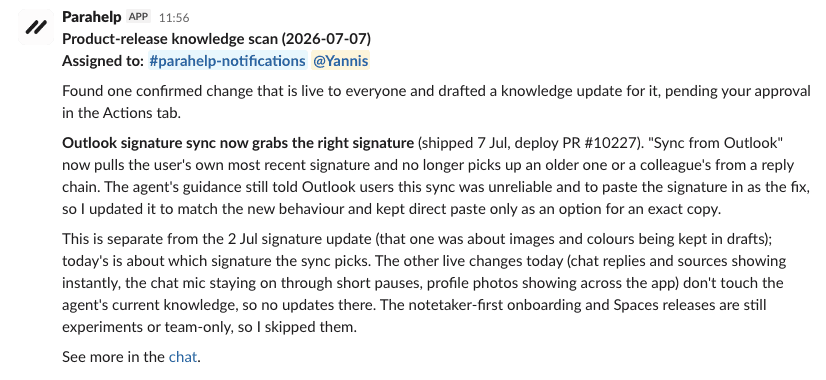
"It has overall helped us cut down the time to KB by ~55% and saved me hours of testing product behaviors myself - rather, I just read the update and validate before approving."
- Yannis
The whole company got closer to customers
Besides resolving customers' issues, support also acts as the voice of the customer inside Fyxer.
Before Parahelp, gathering those insights was difficult.
"We were sharing anecdotes instead of evidence, which made it difficult for engineering to act on."
- Yannis
Today, everyone can get those insights by using Parahelp.
"Now, we share each insight along with customer IDs and ARR. I have members from product and engineering coming to me asking for access to Parahelp so they can query things themselves about the part of the product they look after."
- Yannis
Recently, someone in user research wanted to reach out to customers about a new feature in beta. She prompted Parahelp from Slack to list the customer IDs of every customer who had asked for that feature, and then enriched the list with CSM names from HubSpot in the same [Parahelp Internal Agent] task. Within a few minutes, she had a report of ten customers to invite to the beta.
"15% of our roadmap for Q3 is because of the Parahelp insights that we delivered within the company."
- Yannis
Looking back, what Yannis worried about most never happened. Support at Fyxer didn't become impersonal when AI came in. Customers get their issues resolved faster than ever, the most sensitive requests still get human judgment, and the insights from every conversation now make their way to the teams building the product.
The whole company ended up closer to customers than it was before Parker.
